
The first reader of your website is no longer a person
A buyer types a question into ChatGPT and receives an instant answer. A founder asks Claude to compare four vendors and expects a clear recommendation. A marketing lead runs her shortlist of agencies through Perplexity and trusts the summary it returns. In every case, the first thing that visits your website is a machine. It reads what it can extract, decides what is worth surfacing, and writes a summary that your potential customer reads before they ever see your homepage.
The summary becomes the first impression. For most businesses, the homepage becomes the second impression if a visitor makes it that far at all.
Most websites we audit for clients were not designed for this. They were designed for a human visitor who arrived through a Google search result, scrolled the hero, and decided in seven seconds whether to keep reading. That kind of visitor still exists. But there is a new visitor now, one that does not scroll at all. This visitor parses the page structurally, scanning for clarity, hierarchy, and intent before committing to read a single sentence.
What the machine sees that the human ignored
A human visitor brings context to your website, having perhaps heard the company name from a colleague or seen a social media post last week, so they already know roughly what the product does and your website simply fills in the rest of the details for them.
The machine has none of that. It reads the words on the page, extracts what it can structurally infer, and writes a summary based on what is actually there. If the homepage opens with "We help businesses unlock their potential," the machine extracts "vague consulting." If it opens with "Payment infrastructure for the internet," the machine extracts "payments company, B2B, infrastructure-level."
The companies that read best to AI are the ones with the clearest copy. They name what they do, who it is for, and what makes them different in the first 200 words of the homepage, in plain language, without metaphors that need context to land
The most concentrated work we do with clients now is on that first 200 words.
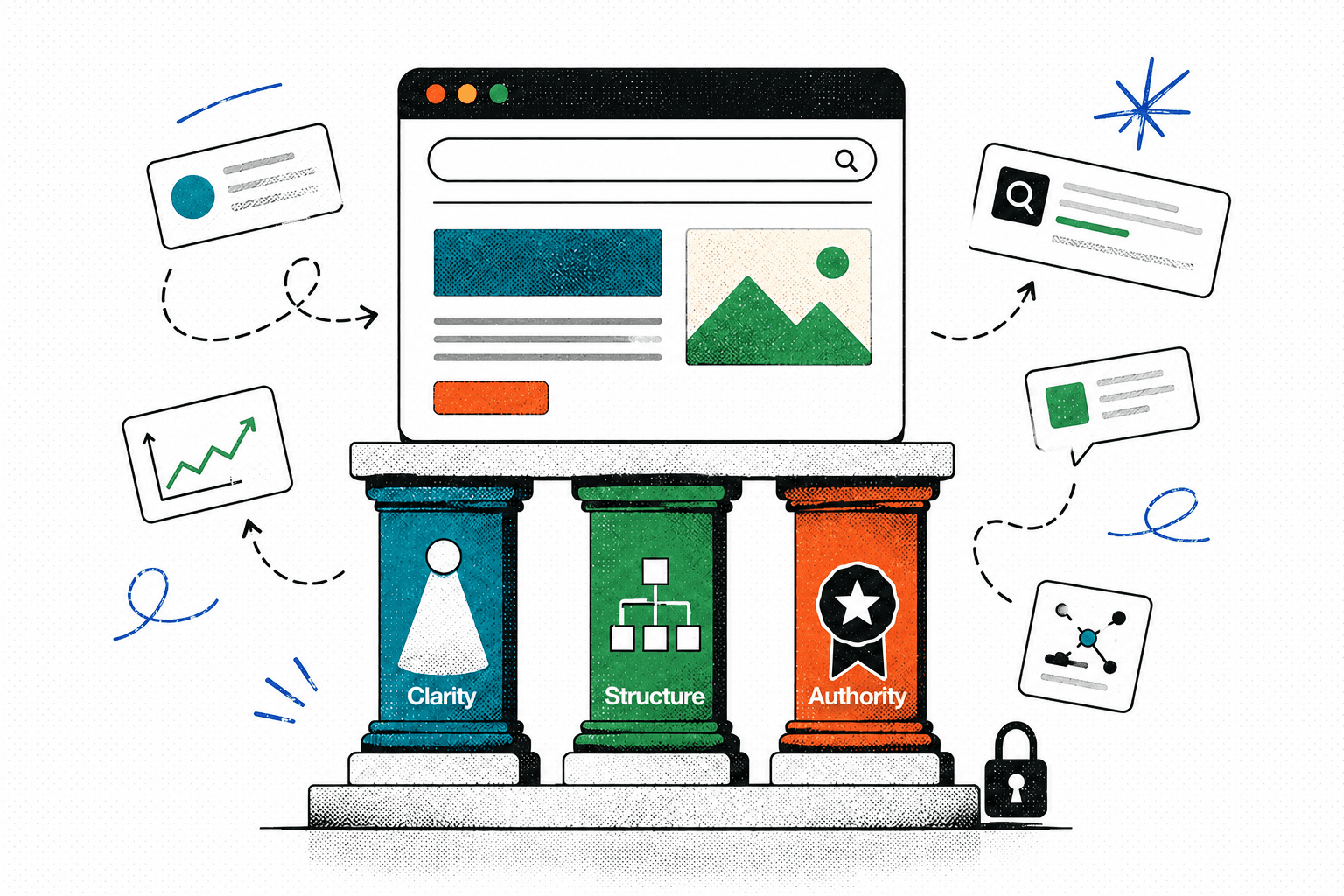
Three things that matter more in the AI search era
1. The category claim
Every company already occupies a category in the market. The website’s job is to define that category clearly and immediately. In 2026, a line like “the [category] for [audience]” carries more weight because AI systems read, interpret, and reuse it.
When the positioning is unclear, the interpretation becomes unclear too. Yet many companies still bury their category definition deep into the homepage. State it plainly at the top, then build emotional resonance afterward.
2. The proof layer
A human believes you when you say "trusted by industry leaders" with three logos. A machine reads the customer names, the specific case study numbers, and either finds them or doesn't. The proof must be machine readable, so named customers with specific outcomes on real dates carry significantly more weight than vague praise.
A statement like "Increased qualified pipeline by 38% in two quarters at [named company]" holds far greater value for an algorithm than ten testimonials declaring a "game changing partner." Being specific and slightly stale will always outperform being vague and artificially evergreen.
3. The distinctive shape of the writing
The machines have grown proficient at writing, which means every company relying on AI to draft its homepage now produces text in the same statistically predictable voice. This output is smoothed out with sentences averaging eighteen words and vocabulary anchored safely in the middle.
The companies that truly stand out after an AI summary are those whose writing possesses a distinct shape the machine cannot average away, a deliberate mix of short and long sentences, specific words chosen over generic categories, and a texture that would only worsen if the machine were asked to clean it up. Your copy represents the part the machine reads, while your visual system is the part the machine discards.

The website is the only piece of the internet you actually own
Social platforms continuously change their algorithms, and AI search rewrites the discovery surface every six months. The companies that chase every new wave without a stable foundation never achieve true compounding growth. The ones that compound their success have a home they fully own, which is a website where the copy, the structure, and the identity system all remain under their direct control.
Everywhere else, you are merely renting attention from platforms that can change the rules at any time. This fundamental truth explains why we spend more time on websites now than we did three years ago. A social presence is merely a tactic for short term engagement, but an AI-readable and well-structured website is a permanent strategic asset for long term brand value.
What we tell clients during brand identity work
Three things in this order. First, write the category claim in plain language at the top, and if the company is too early for a clear category, name the specific problem it solves for the specific customer. Second, treat the proof layer as part of the visual system rather than a footnote, with named customers, specific outcomes, and real numbers designed with the care of the hero treatment. Third, write the homepage copy by hand and then check it for the smoothed out AI cadence, rewriting any sentence that sounds like a machine would write it.
The website is no longer the second impression of your company. For most of your future customers, it is the first impression, mediated by a machine you cannot brief. Your job is to make sure what the machine reads is what you would want it to say.